AgroIQ

A reference architecture for soil condition sensing and irrigation decision support. Low cost and interoperable, engineered to the security requirements of a critical infrastructure sector, and published so that anyone can build it. Designed and documented by Carlos Andrés Yoncón Changkuón since 2019.

What it is

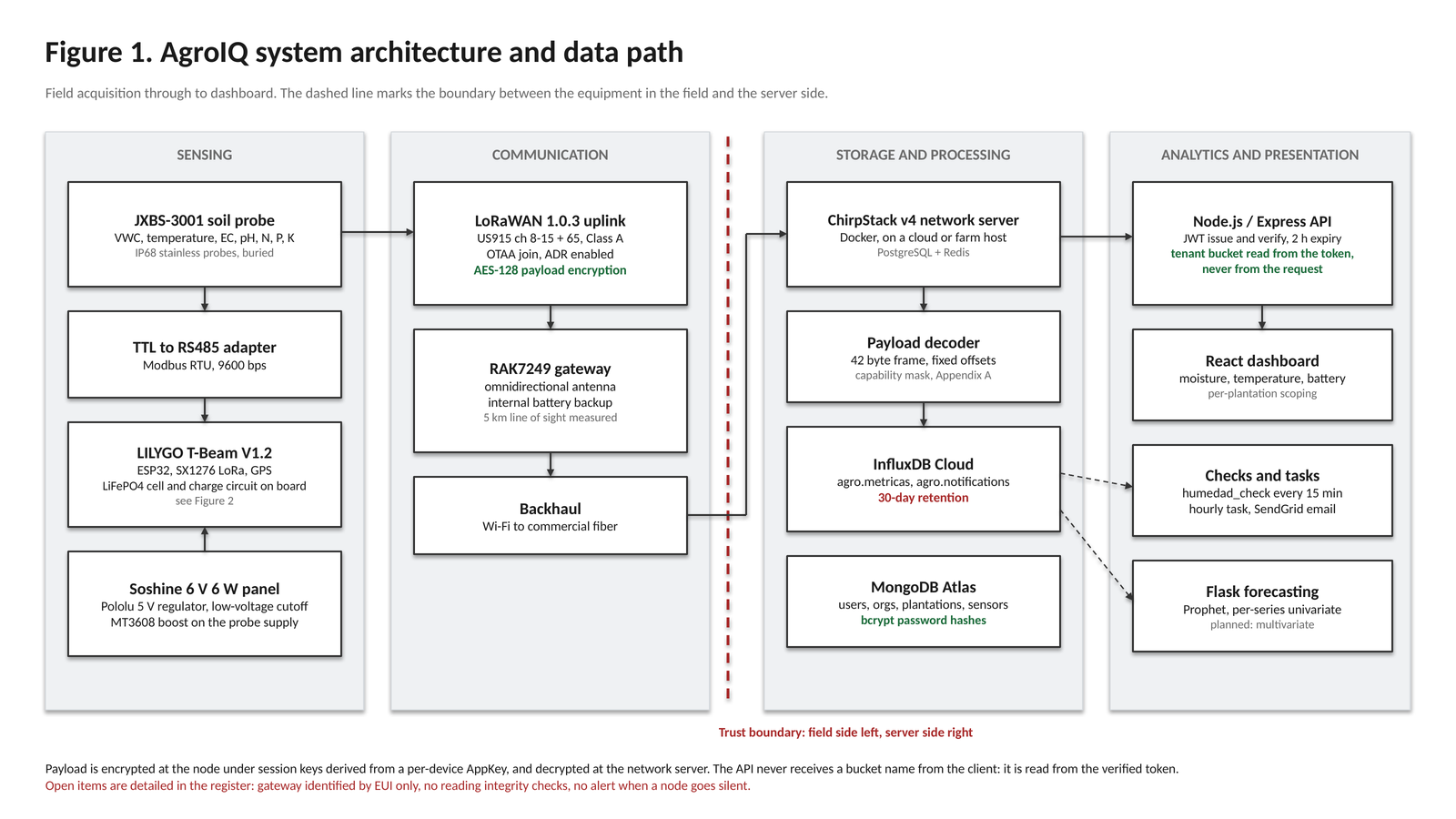
Four layers: an industrial soil probe on Modbus RTU; an ESP32 node that transmits over LoRaWAN on an unlicensed band; a self hosted ChirpStack network server; and time series storage with a dashboard. A sensing node has no internet address and runs no service that accepts connections, so a farm puts its gateway on the internet and none of its sensing points.
Sensing node

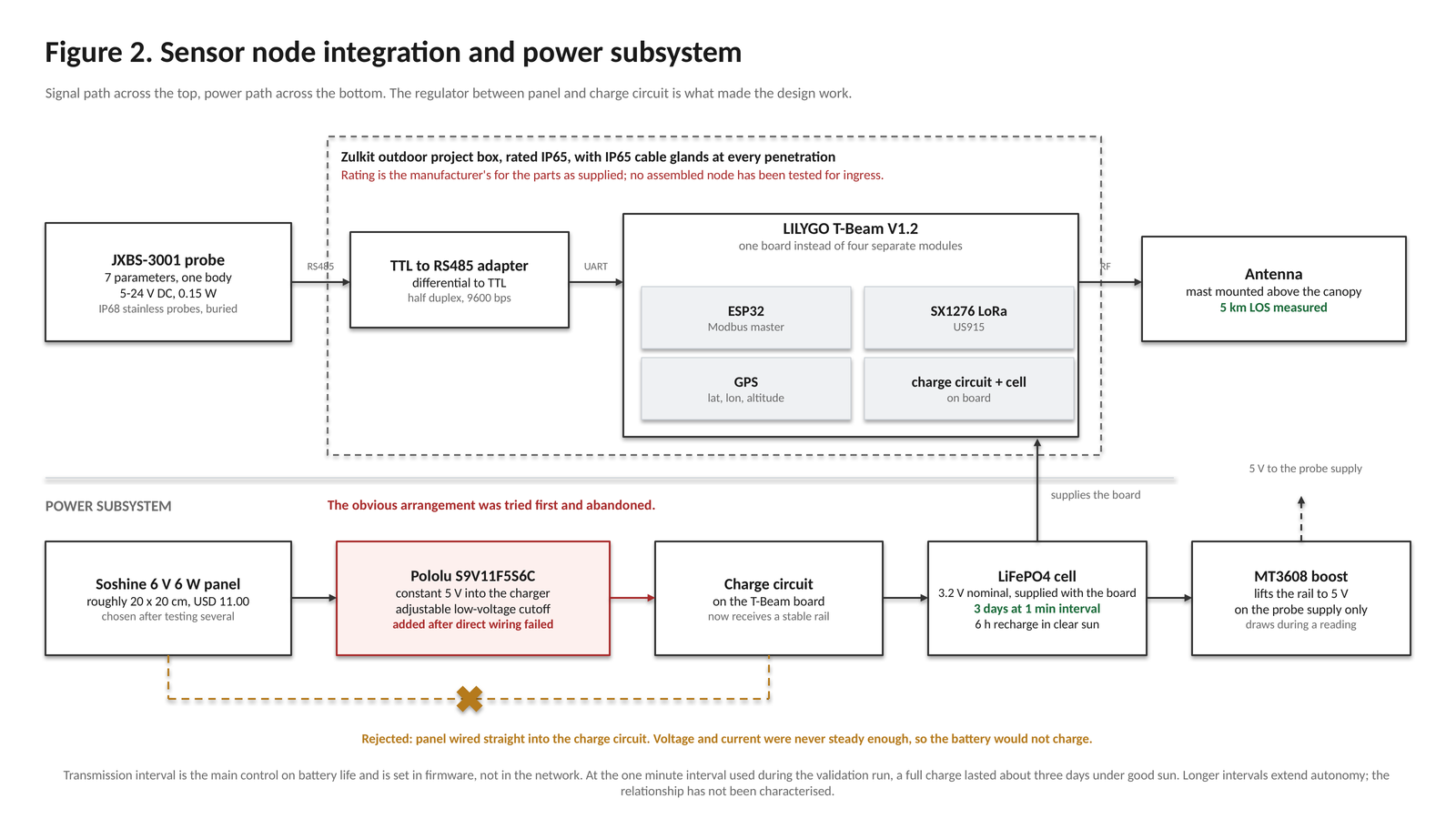
An ESP32 node with an industrial soil probe on Modbus RTU, powered by a small solar panel. Soil temperature and moisture are the readings in use.

Radio link

LoRaWAN on an unlicensed band, measured at 5 km line of sight from one gateway. No node carries a subscription.

Network server and storage

A self hosted ChirpStack network server. Readings go to a time series store, scoped to each farm on every query.

Dashboard

Readings by node and plantation, and a forecasting service. Irrigation recommendations are not built yet.

Where it stands

The architecture runs end to end. It operated for thirty one days at two sensing points in a covered greenhouse in Guayaquil, Ecuador. That run shows the path from probe to dashboard works. It is not a field trial and makes no agronomic claim. Validation on farms in the United States is the work ahead, and everything still incomplete or unvalidated is listed in the register published with the design. The technical record, version 12, is archived at https://doi.org/10.5281/zenodo.23087515. What is published, and under which license, is set out on the license page.

How it works

Sensing node

The node reads the probe, encrypts the reading under keys unique to that device and transmits it over LoRaWAN. It has no internet address and accepts no connections.


Gateway

One gateway per farm receives every node in range and forwards the frames to the network server over the farm's internet connection.


Network server and storage

ChirpStack authenticates and decrypts each frame, decodes it and writes the fields to the time series store.


Dashboard

The application reads each farm's data from its own store and presents it by node and plantation.


AgroIQ system architecture and data path

System architecture and data path. Click to enlarge.


Sensor node integration and power subsystem

Sensor node and power subsystem. Click to enlarge.

Cost to build

A field ready node costs USD 231 to build, in an IP65 housing on a mast. One gateway, USD 469 with antenna and backup battery, serves every node in its range. No node carries a subscription.

These are build costs, not a price.